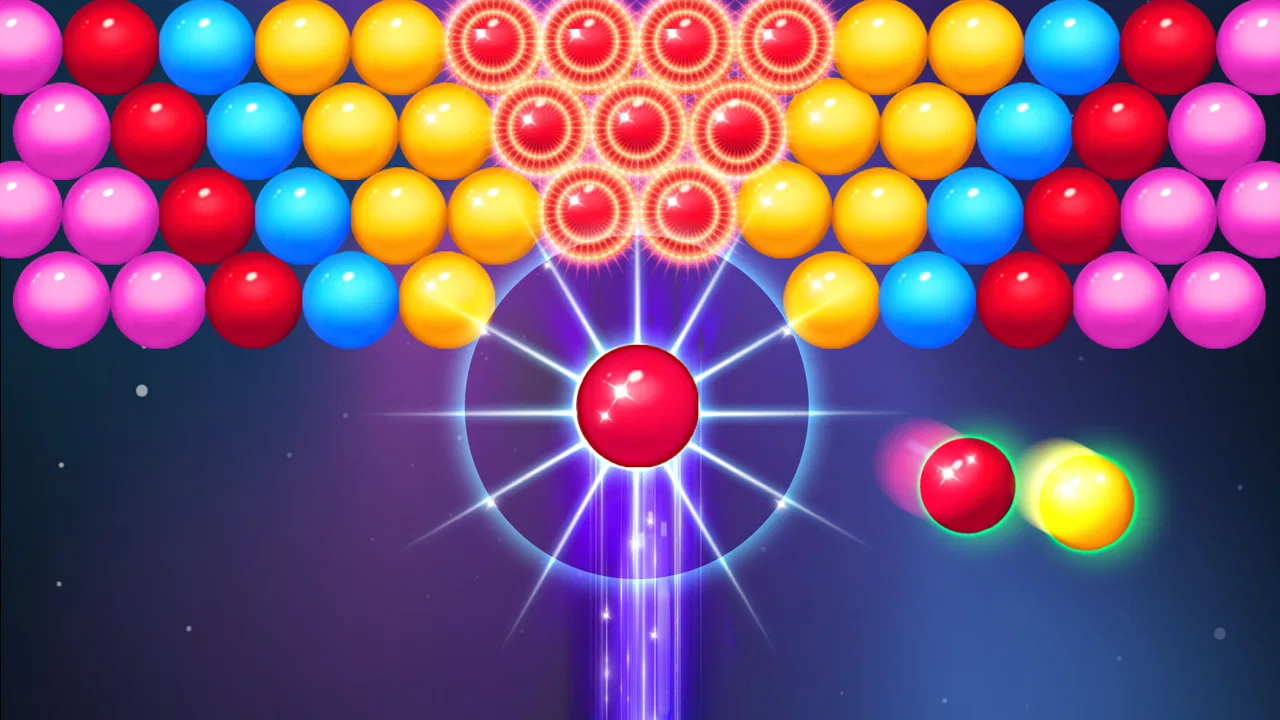
Aura Bubbles
- 4.2
- Rating
- 10.00M
- Installs
- Free
- Price

 Analysis by App-foxy
The first thing I noticed in Aura Bubbles is how quickly it gets to the point. There is no long learning curve to cross before the game becomes playable: you start by aiming at bubbles and balls, then watch the board react to each shot. That directness suits the arcade format well. I can open it for a short break, understand the immediate objective, and begin making decisions without studying a complicated control system.
That simplicity is also the game’s main promise. Developed by Blast 2 Fun Games, this free arcade title places its action in space-themed levels built around popping Aura Bubbles and blasting balls. It is aimed at Everyone, so the presentation and basic interaction are accessible to a wide audience. In my experience, the appeal is less about a deep story and more about the small satisfaction of lining up a shot, clearing part of the screen, and deciding what to do next.
From the first shot to the next session
I find that the most useful way to judge a quick arcade game is to notice whether its simple opening still gives me a reason to return. Here, I’ll look at how the shot-and-retry rhythm holds up beyond a first try, and what the current version can—and cannot—tell an existing player about the game’s direction.
You May Also Like

 Blood Strike: 2.5 Anniversary
Blood Strike’s Loadouts Turn Every Drop Into a Tactical Gamble
A close look at Blood Strike’s custom loadouts: how fast access to signature weapons reshapes its battle royale rhythm, rewards preparation, and narrows the gap between fights.

 Pandora - Music & Podcasts
Pandora’s Music Is Easy to Start, but Harder to Recover
Pandora’s strength is its low-effort path from a seed to a station. Its weak spot is how much confidence it asks you to place in connection, setup, and quiet recovery.

 8 Ball Pool
 Is Built on Rivalries, Rematches, and Routine
A close look at the rivalries, rematches, shared routines, and unanswered safety questions that turn a quick pool match into a persistent mobile community.

 Samsung Music
’s Quiet Strength Is Playing What You Already Own
Its reach comes less from spectacle than from dependable access to a personal library. That simplicity is both the app’s strongest retention engine and its ceiling.

 AccuWeather: Weather Radar
AccuWeather Review: A Quick, Clear Forecast for Everyday Decisions
For everyday plans, the best forecast is the one you can understand quickly. AccuWeather makes rain timing, radar, and local conditions easy to act on, with a few trade-offs.

 Hill Climb Racing
Why Hill Climb Racing Still Turns Crashes Into One More Run
A tiny car, a bumpy hill and one more upgrade: Hill Climb Racing keeps resurfacing because its simple chaos makes every near-miss feel personal.
More From Our News Desk



The first action is easy to understand
The opening interaction does not ask for much commitment. I point, fire, and immediately get a visual response from the board. That matters in a casual arcade game because the first few seconds determine whether the experience feels inviting or confusing. Here, the basic relationship between action and result is clear enough that a new player can begin experimenting instead of worrying about controls.
The space setting gives the otherwise familiar bubble-blasting idea a distinct mood. It is not trying to turn the game into a full space adventure with exploration or character management. Instead, the theme frames each puzzle-like screen as a compact obstacle course. The result is a game that feels lighter than a traditional action title and more active than a purely passive matching experience.
I found that the best way to approach a new level is not to fire immediately just because a target is available. The first useful habit is to scan the arrangement and consider which shot might produce the most helpful chain or open the safest route. Even when the board looks simple, pausing briefly can make the difference between a clean start and a sequence of awkward shots.
That small pause is one of the game’s more interesting trade-offs. The controls encourage quick reactions, but the board rewards at least a little planning. Players who treat every screen as a reflex test may waste opportunities. Players who look for the most efficient first move can make the action feel more deliberate without losing its casual character.
Why the feedback rhythm keeps the loop moving
The satisfying part of the loop comes from the feedback after each successful action. A bubble disappears, the arrangement changes, and the next shot becomes easier to read. That sequence gives the game a steady rhythm: act, see the result, reassess the board, and act again. It is a modest form of progress, but the short distance between decision and response makes it easy to stay engaged.
I especially like this rhythm when I have only a few minutes. A quick session does not require me to remember a complicated plot or rebuild a strategy from a previous visit. I can focus on the screen in front of me, enjoy the immediate response, and stop when the current attempt ends. That makes it a practical choice for a commute, a waiting room, or a short break between other tasks.
The feedback is most useful when I treat misses as information rather than simply as failures. A shot that does not clear as much as expected can reveal how the remaining bubbles are positioned. On the next attempt, I can adjust the angle or choose a different target. This makes the game’s repetition more meaningful: the reset is not only a restart, but also a chance to apply what the previous board taught me.
There is a limit to how much depth this creates. The central interaction remains straightforward, and players looking for elaborate combos, long-term character development, or a large strategic layer may find the loop too narrow. Its strength is concentration, not complexity. I would recommend it to someone who enjoys compact arcade decisions, but not to someone expecting the breadth of a large puzzle campaign or a competitive action game.
Rewards that make a clear board feel worthwhile
The immediate reward is the changing playfield itself. Clearing targets gives me a visible sense of progress, and the board becomes less crowded as successful shots accumulate. That visual change is important because it turns an abstract score-oriented action into something I can read at a glance. I do not need a long explanation to understand that a good shot has made the situation better.
The game works best when I focus on creating favorable follow-up positions rather than chasing one spectacular move every time. A shot can be useful because it removes a troublesome cluster, exposes a better angle, or simplifies the next decision. That is a practical tip for new players: measure success by how much easier the next shot becomes, not only by how dramatic the current effect looks.
Because the title is free to download, it is easy to try without making an immediate purchase. The store listing places in-app purchases between $0.99 and $104.99 per item, so I would approach optional spending carefully. For a casual player, the sensible starting point is to play naturally and decide whether any purchase genuinely improves the experience. The free entry point is attractive, but the broad range of possible item prices means it is worth keeping an eye on spending, particularly if children are using the device.
I also appreciate that the age rating is Everyone, which makes the game easier to share within a household. Still, an age rating does not replace sensible supervision around purchases. If I were setting it up for a younger player, I would make sure the device’s purchase controls were configured before handing it over. That is not a criticism of the bubble-blasting loop itself; it is simply a practical step when a free game includes optional paid items.
How a session resets without feeling like wasted time
The reset is central to why another session begins. Once an attempt has run its course, the next board offers a clean opportunity to try a different opening move. I do not have to carry a complicated inventory, rebuild a character, or spend a long time preparing. The cost of trying again is low, which is exactly what I want from a pick-up-and-play arcade game.
That low friction can be useful in everyday situations. Imagine waiting for a friend who is running late. I can play one short attempt, put the phone away when the friend arrives, and return later without needing to reconstruct a detailed plan. The same applies to a brief evening break: the game gives me a complete little activity rather than demanding a large block of uninterrupted time.
At the same time, repeated resets can expose the game’s limits. If I want a strong sense of permanent progression, a reset-based arcade loop may feel thin. The attraction depends on enjoying improvement in the moment: better aim, smarter target selection, and a cleaner run. Players who need every session to unlock a lasting upgrade may prefer a progression-heavy puzzle game, a campaign-based title, or an arcade game with a more elaborate achievement structure.
My advice is to decide what kind of satisfaction you want before installing it. If you enjoy replaying a compact challenge to improve your decisions, the reset supports that habit. If you mainly play to collect persistent rewards or follow a narrative, this may not hold your attention for long. The game is not failing when it stays simple; it is simply serving a narrower purpose.
Useful habits for getting more from the levels
One useful approach is to separate observation from firing. I take a moment to identify crowded areas, possible openings, and targets that could make later shots awkward. This is more effective than tapping quickly through every available opportunity. The game’s accessible controls make fast play possible, but a deliberate opening often gives the rest of the attempt a better shape.
A second habit is to value board control over immediate spectacle. If two targets are available, I prefer the one that leaves a clearer line for the following action. This can feel slower than simply choosing the largest visible cluster, yet it reduces the chance of ending up with a difficult arrangement. That small change in thinking is where the arcade loop gains some tactical texture.
A third tip is to use each failed attempt as a short experiment. Rather than repeating the exact same shot, I change one decision at a time. I might alter the first target, try a different angle, or delay a tempting move. That makes the reset informative and prevents sessions from becoming mindless repetition. It also helps answer a question many new players have: whether improvement comes from luck or from learning the board. In my experience, better observation can make a noticeable difference.
Finally, I would avoid judging the game during a single rushed session. Its appeal comes from the accumulation of small responses, not from a dramatic opening sequence. A player who gives it several relaxed attempts will get a clearer sense of whether the action-and-reset rhythm fits their taste. Someone who dislikes repeating compact boards will know fairly quickly that the format is not a match.
Where it fits among familiar arcade alternatives
Compared with a standard bubble shooter, this game’s space presentation gives the familiar act of clearing targets a more energetic frame. Compared with a fast reflex arcade game, it leaves more room for looking and planning before committing to a shot. That middle position is its most useful identity: it is approachable enough for casual play, but not so automatic that every move feels meaningless.
It is less suitable than a traditional match-three game for players who want a broad collection of tile patterns, boosters, or a heavily structured progression path. It is also less suitable than a twitch-focused arcade title for someone who wants constant speed and pressure. I would choose this one when I want a screen-based challenge that is active but still gives me time to read the situation.
The game’s scale also affects how I compare it with alternatives. It is not the kind of title I would install for a long narrative journey or a social competition. Its value is concentrated in the individual attempt. That makes it easy to recommend as a companion game, especially for people who like switching between short rounds rather than committing to one large experience.
Performance, access, and who should try it
The current version is 9.3, and the listed minimum operating system is Android 5.0. That gives the game a relatively broad device range on paper, which is helpful for people using older Android phones. I would still judge the final experience by the particular device, especially if storage, battery condition, or general system performance is already a concern, but the stated compatibility makes it approachable for more players than a newer, demanding 3D game.
Its scale is reflected in its audience: the game has passed ten million installs, with an average rating of 4.2 from around thirty-four thousand ratings. Those figures suggest that the straightforward arcade formula has found a substantial audience, while the rating also leaves room for individual preferences and frustrations. I would read that combination as encouragement to try it, not as a guarantee that every player will enjoy the repetition.
I think it is a strong fit for casual players, families looking for an Everyone-rated arcade option, and anyone who likes aiming, clearing, and retrying without a lengthy tutorial. It can also suit experienced mobile players who want a lighter title between more demanding games. The best use case is a short, repeatable break where immediate feedback matters more than a permanent sense of advancement.
I would skip it if I need a deep story, complex multiplayer, extensive customization, or a progression system that carries major changes from one session to the next. I would also be cautious if I am easily tempted by optional purchases, since the game is free to start but includes paid items. In that situation, a paid arcade title with a simpler purchase structure may be a better personal fit.
My verdict on the action-feedback-reward-reset loop
After spending time with it, I see Aura Bubbles as a focused arcade game built around a clean cycle. I make a shot, receive immediate visual feedback, improve the board, reach the end of the attempt, and begin again with a better idea of what to try. That loop is not revolutionary, but it is easy to understand and surprisingly effective when I want a small challenge without a large time commitment.
The strongest part is the connection between action and consequence. Even a simple shot can change the next decision, and that gives the board enough movement to keep a short session from feeling completely automatic. The reset then lowers the pressure: a poor attempt is not a major setback, just another chance to adjust the opening and read the arrangement more carefully.
The main weakness is the same feature that makes it accessible. The core loop stays compact, so players wanting richer systems may outgrow it. Optional purchases also deserve attention because the game is free but offers items across a wide price range. Neither issue ruins the experience, yet both should shape expectations before installing it.
For me, the recommendation is clear but specific: try it if you want a free, space-themed bubble-blasting game for short sessions, readable decisions, and quick retries. Keep your spending controls in place, give the levels a little thought instead of firing randomly, and judge the game by whether its repeated rhythm relaxes or annoys you. If that rhythm feels satisfying, Blast 2 Fun Games has made a dependable little arcade distraction; if you need lasting progression or substantial variety, another category of mobile game will serve you better.
FAQs for Aura Bubbles
01What is Aura Bubbles and how does the game work?
Aura Bubbles is a casual bubble-shooting game built around aiming, matching, and clearing groups of bubbles. You usually launch a colored bubble toward the playfield and try to connect it with bubbles of the same color. Creating larger combinations can clear more of the board and may help you complete level objectives. The experience is easy to understand, although later stages can require careful planning and accurate shots.
02Is Aura Bubbles free to download and play?
Aura Bubbles can generally be downloaded at no initial cost, allowing players to try the core gameplay without purchasing the app first. However, free games may include advertising, optional in-app purchases, or extra content that requires payment. Before downloading, it is worth checking the current store listing for the exact purchase options, advertising policy, and whether any features such as boosters, lives, or cosmetic items are sold.
03Can I play Aura Bubbles without an internet connection?
Some bubble games allow their main levels to be played offline, which is useful when traveling or when mobile data is unavailable. Nevertheless, features such as advertisements, cloud synchronization, leaderboards, events, updates, and in-app purchases may require an internet connection. Because offline availability can vary between versions and devices, test the game after installation with Wi-Fi and mobile data disabled if offline play is important to you.
04Is Aura Bubbles suitable for children and casual players?
The simple matching mechanics make Aura Bubbles accessible to casual players and beginners, including users who prefer short, low-pressure gaming sessions. Parents should still review the age rating and store disclosures before allowing children to play, especially if the app displays advertisements or offers in-app purchases. It is also sensible to use device-level purchase restrictions and check whether the game collects or shares any personal information.
05What devices and permissions does Aura Bubbles require?
Aura Bubbles should be installed only on a compatible Android or iOS device that meets the version requirements shown on its official store page. The exact storage space and operating-system support can change as the app is updated. During installation, review every requested permission carefully. A simple puzzle game should not normally need extensive access to contacts, messages, or location, so unexpected permissions deserve additional consideration before you approve them.
Pros
- Calming bubble designs create a relaxing visual experience.
- Simple controls make it easy to use without a learning curve.
- Works well for short breaks
- meditation
- or stress relief.
- Minimal interface keeps the experience focused and distraction-free.
- Suitable for users who prefer gentle
- low-pressure apps.
Cons
- Limited interaction may feel repetitive after extended use.
- Relaxation effects can vary from person to person.
- Some features may require in-app purchases or premium access.
- The app may offer little value for users seeking active gameplay.
- Visual animations could affect battery life during longer sessions.

Aura Bubbles
Gallery